Wikidata and the 2024 Open Library Community Celebration
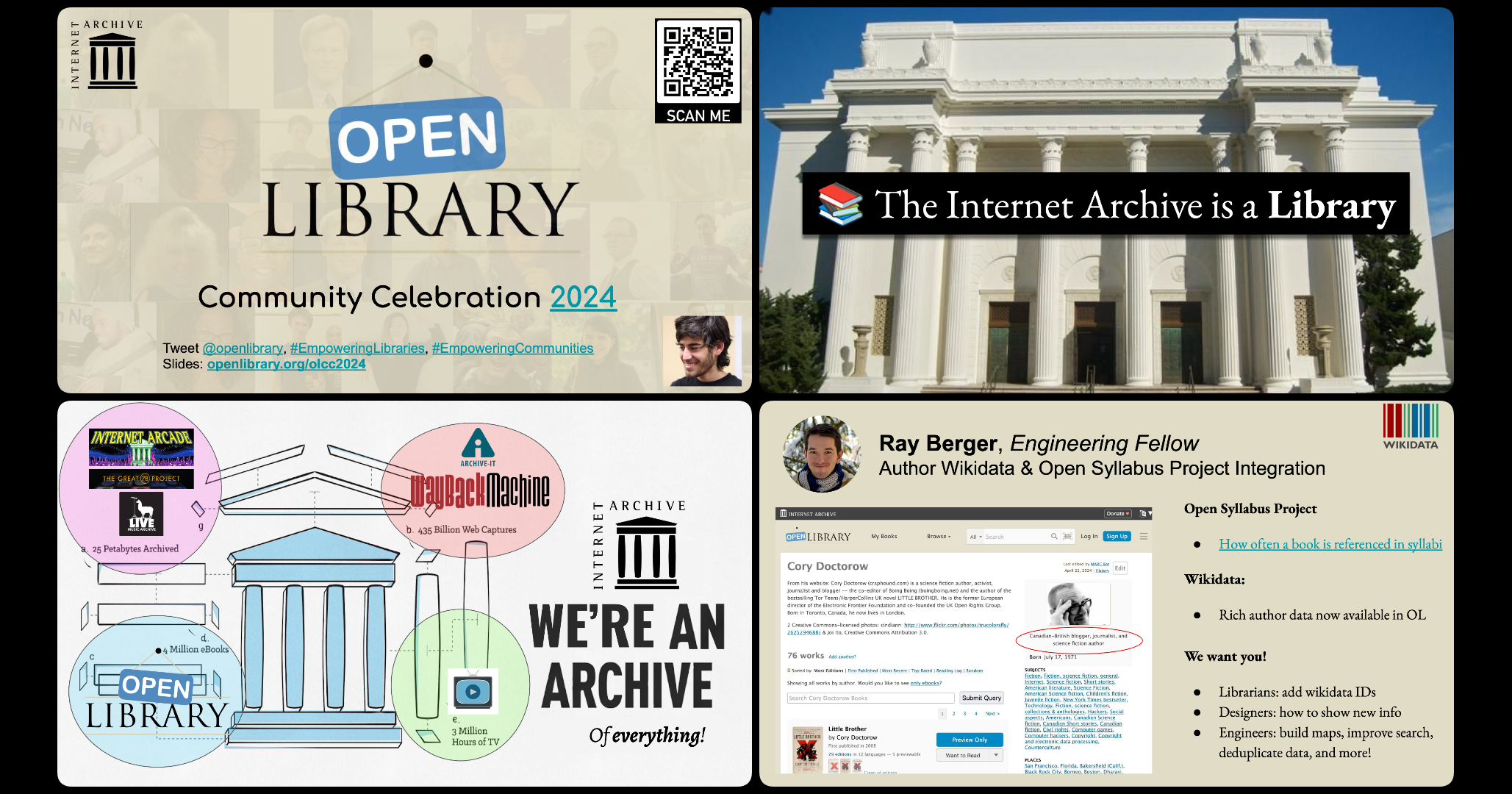
Every October, Open Library hosts a community celebration where volunteers showcase their work from the past year. I had the pleasure of presenting at this year's celebration and would like to share my presentation here.
On a side note, during my recent trip to San Francisco, I missed the in-person meetup at the Internet Archive by just a day, but I still had the chance to meet the team, including Mek, Drini, Scott, and Rebecca, who graciously showed me around. Experiencing the Internet Archive firsthand was truly inspiring, and I highly recommend visiting one of their public events if you get the chance.
My Open Library Contributions
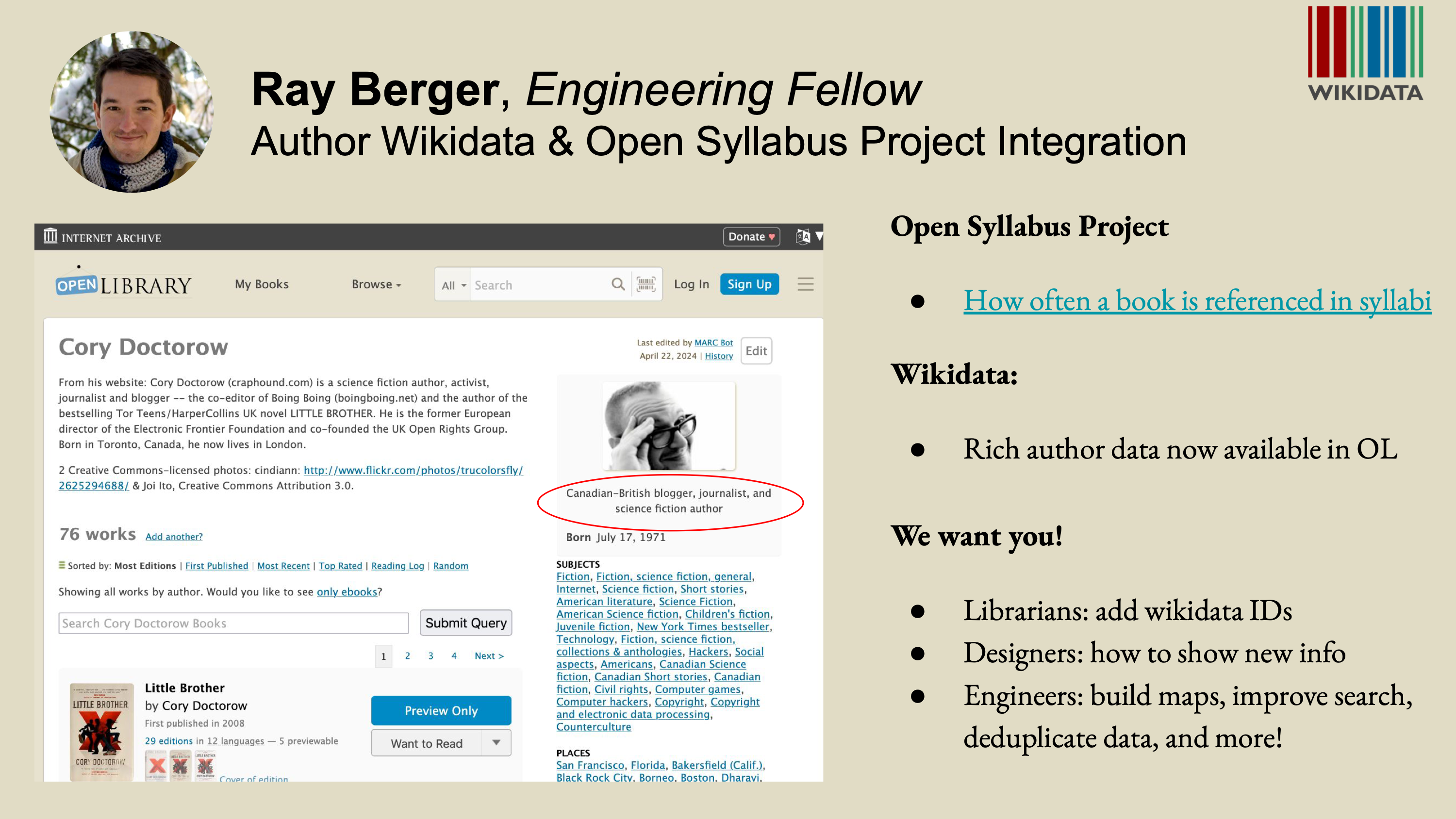
Here is my single slide from the presentation:
Mentoring Volunteers
This year, I dedicated significant energy to mentoring volunteers. Many individuals express interest in contributing to the project, and I am happy to provide guidance and respond to their questions in a timely manner, even hopping on occasional calls. I enjoy this and hope it allows the staff to focus on other important tasks (such as reviewing our pull requests 😅). I strive to foster a welcoming and accessible community, which is a rewarding experience that makes me proud to be part of the team.
Open Syllabus Project Integration
I chose to highlight two projects: the Open Syllabus Project integration and the Author Wikidata integration.
The Open Syllabus Project provides data on how often books are referenced in syllabi, which is now available in Open Library's Solr database.
The integration of the Open Syllabus Project data offers opportunities to enhance search functionality by highlighting books frequently referenced in syllabi. Additionally, displaying this information on book pages can serve as a valuable indicator of a book's relevance within a particular field. While these features are not yet implemented, I hope they'll be coming in 2025.
Author Wikidata Integration
This project has been on my back burner for years. Finally, in the past year, Drini and I worked together closely to get it out the door.
Wikidata is a rich, crowdsourced database of information on various topics, similar to Wikipedia (and run by the same folks). It is easy to query and has contributions from people all over the world, not just book nerds like those at Open Library.
Now, Open Library downloads information for any author with a Wikidata ID. This information is updated when an ID is added to an author and every 30 days thereafter to ensure the data stays fresh.
Currently, as shown in the screenshot of my slide with the red circle, we are only using Wikidata in one place: to display the short description of the author on their page. However, now that the data is integrated into the system, it will be straightforward to add new features.
Soon, we will implement language-aware Wikipedia links. If you are browsing the Spanish version of Open Library, you will see the Spanish link to Wikipedia if it exists; if not, it will display a link in another language. Additionally, I hope we will start importing authors’ photos from Wikimedia Commons. These are two relatively small enhancements that I am excited to see come to fruition. In the long term, we envision creating a map showing the origins of all the authors you have read and more.
Finally, I want to emphasize that this is a great example of utilizing Wikidata while also encouraging people to learn about and contribute to it. When volunteers add information about authors, they contribute to a dataset for the world, not just the Open Library website.
Closing
I've been contributing to Open Library for a few years now and it just keeps getting better. I'm happy I found this community and hope it inspires people to build similarly welcoming and collaborative projects. If you'd like to contribute, contact me or visit the volunteer page. Whether you're a budding librarian eager to contribute by adding missing Wikidata IDs, a designer ready to enhance our author pages and search results, or an engineer interested in building visualizations and improving search functionality, we welcome your skills and passion.
This blog post was not written by AI, but it was transcribed by AI, as I mostly dictated it to my phone.